Tuesday, February 16, 2016

Adios Mexico

La Paroquia, San Miguel de Allende
After a lovely three months stay in San Miguel de Allende, we took our leave on January 26th.

As in the past, we enjoyed our stay, but, perhaps not quite as much as we had in our last few visits.  San Miguel, unfortunately, is becoming a a victim of its own success.

Automobile traffic and pollution are more noticeable (or at least to us) than ever, and there are times when you feel overwhelmed by the tourists.  Still, it remains a magical place and a great place to relax and escape the winter weather.
La Virgin de Guadalupe, patron saint of Mexico

Larry really enjoys the opportunity to improve and practice his Spanish and the Mexican people are overwhelmingly kind, hardworking and gracious.

Before saying adios or farewell to Mexico, we spent three days in Mexico City visiting with our friend, Carole Reedy.

We used to call it DF (day-effay), distrito federale, as many of our Mexican friends had taught us, but now, thanks to a new national law, it is the City of Mexico (CDMX), (ciudad mexico), with many of the same powers of other Mexican States.


Enjoying our luncheon
 It is always so much fun to visit with Carole, who has lived in Mexico for nearly 20 years.  She is American born but has come to love the country, its people and its culture so much that she became a Mexican citizen.

She is a great guide to the City and in previous visits has introduced us to many of its museums and cultural attractions, including the Corrida or bullfighting.

Templo Mayor ruins in the Zocalo

One day during our stay, after a delicious and relaxing lunch at a great restaurant overlooking the ruins of the Templo Mayor (the main Aztec Temple, dating from before the Spanish conquest of Mexico in 1520), we visited the nearby Department of Education (Secretaria de Educacion) to marvel at the Diego Rivera murals.
The murals were painted by Rivera from 1923-1928 and tell the story of the Mexico Revolution.

Restored in the 1990's, they are truly marvelous to behold and study. With very few other tourists or visitors, we were free to wander and explore to our hearts content.

We had planned a stay of half an hour or so and ended up staying more than two hours.  For us, the murals were far more interesting and fascinating than others we had seen in the National Palace or elsewhere.


 Rivera was an avowed Communist and wholeheartedly believed in the Mexican Revolution and through these murals wanted to celebrate its successes in redistributing land and ending illiteracy and generally improving the lot of the Mexican campesino.

His overarching theme seems to be summed up in a banner above one of the murals which loosely can be translated as "True Civilization will be harmony of men with the land and amongst themselves."


Freda Kahlo handing out guns


One of our favorite murals features Freda Kahlo, Rivera's wife and an artist in her own right,   distributing arms to the campesinos.

Although they seemed to have loved each other very much, Rivera and Kahlo had a tumultuous and troubled relationship.  Her fame has perhaps surpassed his in recent times.

Our photos can not do justice to the beauty of the murals nor the impact that they make on the viewer.

We felt so fortunate to be able to see and experience them in person, and should you be in Mexico City--don't miss them!


The Secretariate is a huge complex and after we had finished looking at the Rivera murals, we started to leave only to realize that in another part of the building there were some works by another famous Mexican muralist, David Siqueiros.

We were not as taken with them as we were with the Rivera murals.  They are very monumental and abstract--so perhaps a little less approachable.

What a great way to close out yet another visit to Mexico.  Thanks once again to our friend Carole for turning us on to this great find and for always being willing to share her Mexico City with us.

Now we are back in Denver for the foreseeable future.  It is great to be back in our own place and to be near Bryn, Grant and Charlie.  We got back in town just in time to help celebrate his 4th Birthday--an important milestone.

And to experience Super Bowl 50 with a million other Bronco fans !  It was a SUPER welcome !!


Wednesday, February 10, 2016

Patzcuaro Adventure

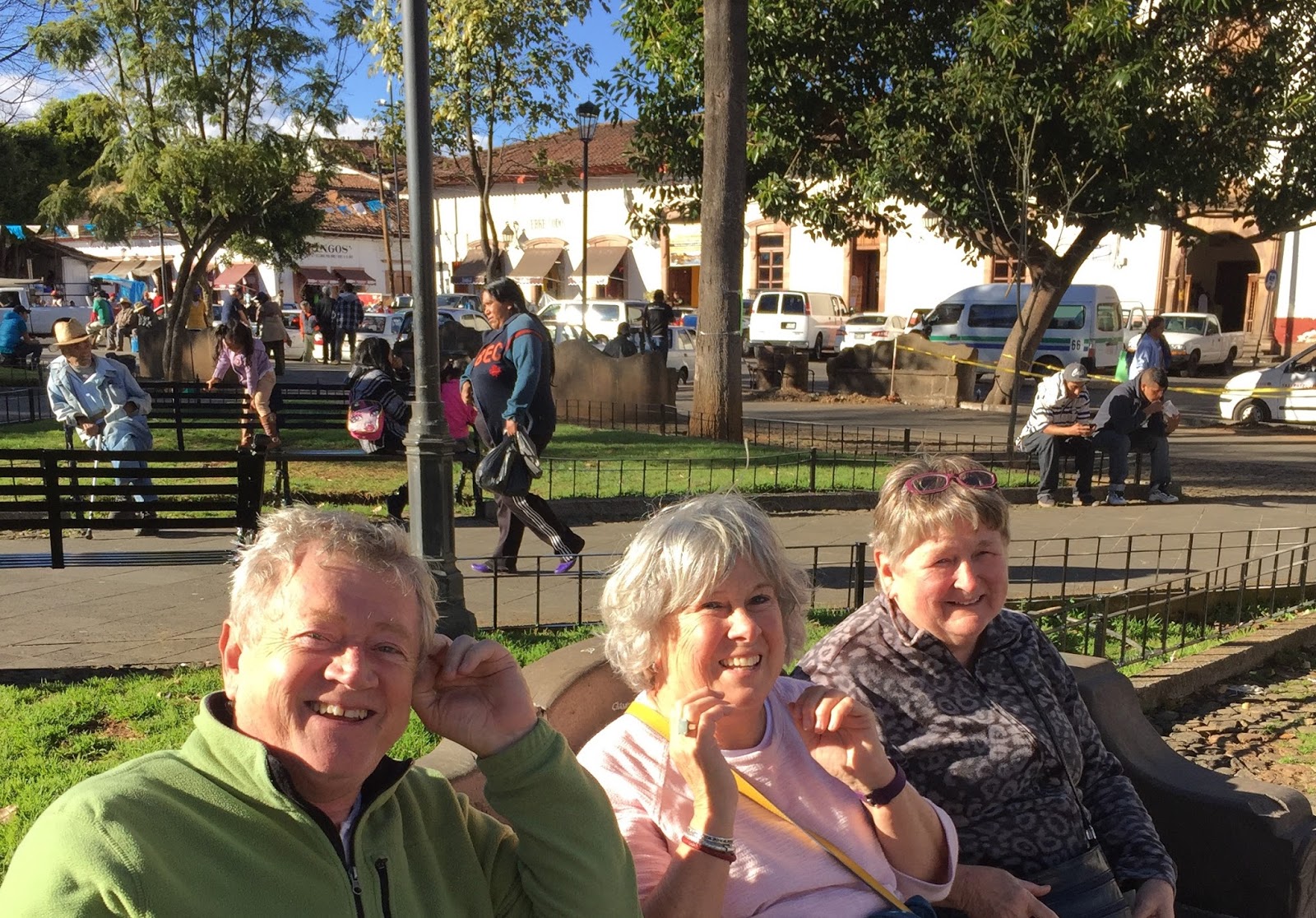
On the sunny square with Susie
 We had such a nice, if short, visit to Patzcuaro--a small city in the Mexican state of Michoacan, with our friends, Mart & Bob Larson and Susie Morgan.

Our drive there took a little over three hours--which was just about right, since the five of us were crammed into a little Nissan Versa.

A couple resting near our rental house
Unfortunately, our drive back to SMA took about seven hours, as we got delayed for more than three hours outside of the city of Morelia.  A gasoline truck overturned (just about five minutes ahead of us), and the police had to close the road to clean up all the spilled fuel.

But we are so happy that we made the trip.  Patzcuaro is very different from San Miguel de Allende.

Although a town that attracts a number of tourists, you notice them a lot less.  It is quite peaceful with many colonial style buildings and some beautiful vistas.
Sue posing with a Gertrude namesake


We rented, through AIRBnB, a wonderful three bedroom house just a couple of blocks from the picturesque and charming main plaza. It was very comfortable and full of local arts and crafts.


Some of the highlights included:

1. The Gertrudis Bocanegra square that honors a female hero of the Mexican struggle for Independence;

Entire history of Mexico on one wall


 2. A 1942 Martin O'Gorman  mural in the local public library, depicting the history of Mexico.

Mexico, unfortunately, has experienced so much corruption and violence and its people so much repression, even today.  The mural was a great history lesson as well as an exceptional piece of public art.


Card Catalogue


It was interesting and nostalgic to see and use the card catalog--something that most American public libraries have abandoned.

The card catalog, though, was the mainstay of most libraries throughout the 20th century and still can be very useful. (You can take the librarian out of the library, but you can't take the library out of the librarian.)

Larry, Mart and Bob in the Casa de Onze Patios courtyard
3. A beautiful and historic old convent, called the House of Eleven Patios (Casa de Onze Patios) that featured a wide variety of small stores that sold local arts and crafts.

Unlike many tourist sites, the shops all seemed to be quite different, often specializing in one type of craft like textiles, lacquer goods, musical instruments, toys, or jewelry.

We spent a couple of hours walking around and shopping.  It was so peaceful, entertaining and interesting.

4. A very interesting museum (Museo de Regional de Arte Popular) where a guide lead us through rooms displaying local crafts from prehistoric times to the present.

In the center were ruins of an ancient prison, where some wall portions were still intact and showed dots prisoners had dug into it to mark the days.
Lovely fountain and courtyard in a smaller building

Same building as above, but showing balconies

Larry and Bob posing at nice fountain in Casa de Onze Patios

Display of figurines in Museo Regional de Arte Popular

View from middle balcony of our rental house

Larry in our rental house bedroom, ready to leave


Bob, Susie and Sue seated; Mart and Larry standing
Even though our AIRBnB house had a great and fully equipped kitchen, none of us really wanted to cook.  Fortunately, we found a great local restaurant called Lupita's.  We ate a couple of meals there and had a great time relaxing and being with our friends.

There are so many places to see and visit in Mexico--and we have done so few--but we know that we have them to look forward to.

Friday, December 25, 2015

Merry Christmas and Happy 2016 !!

Nacimiento in Our Apartment

Feliz Navidad y Prospero Ano Nuevo from San Miguel de Allende, Mexico


Why San Miguel and why Mexico?  Despite the American press's depiction of Mexico as a dangerous, crime infested place, we have found it to be just the opposite.


Nacimiento in one of the town squares


Life in San Miguel is peaceful and stress free. The Mexican people are invariably kind, gracious and welcoming. 

The festivities surrounding the holidays are lovely and very sweet, usually involving lots of small children.


Community Christmas tree in front of Parroquia


Celebration of the Christmas season is taken very seriously. Starting with the Virgin of Guadalupe Day (December 12) until the arrival of the Three Kings (January 6), the town is filled with decorations, lights and parades.

From December 16 through Christmas eve, many neighborhoods or churches form "Posadas"--a small procession of people walking behind a flat bed truck on which children pose as Mary and Joseph.

Street doecorations


They are acting out looking for a place to stay prior to the birth of Jesus.  Behind the truck march a small group of musicians and some little children singing a traditional song, which asks for lodging. 

They trail through several streets and finally stop at a home which has agreed to host the pilgrims with candy and warm drinks waiting.


Poinsettias in our apartment
Everywhere you look, there are poinsettias, or Noche Buenas as they are called here in Mexico. All of the city parks are a-strewn with them, since there is no danger from frost.  We, of course, had to buy some for our little apartment and it joined our nacimiento.
Tin tree at entrance to our apartment


There are a lot of concerts and musical celebrations.  One of our favorites was a children's choir presentation at one of the city's oldest Catholic churches, El Oratorio.

We were one of the few gringos in the audience, and although many of the readings and prayers were beyond our Spanish comprehension, most of the the carols were familiar. We took a short video which we thought we would share. (It's probably not viewable on your email, but you can go directly to the blog to see it.)


Of course, we miss being with our family this time of the year, but we know we will see them soon; meanwhile, we content ourselves with snapshots, Skype sessions, and shared photos.

Snow Day for Bryn & Charlie

Charlie's school photo

Erin's Christmas Card

So from our Family to yours--a very Merry Christmas and we hope to see many of you in the New Year!


Wednesday, December 23, 2015

Peru, Part IV: Lima

A Happy Fella
Staying in Lima was a nice way to finish our all too short visit to Peru.

Fortunately, our Lima AirBnB was so much nicer than our Cuzco experience, providing us a modern, clean two bed, two bath apartment in one of the nicer neighborhoods in Lima (Miraflores.) We have come to rely on AirBnB in our travels, so we hated to have our faith in it shaken.

As we indicated earlier, Lima is a huge, traffic clogged city.  Very first world and cosmopolitan in some areas, full of world class shops, restaurants and museums, it's home to 10 million people. At times it seems all of them are in their cars on the roads and streets of the capital.

Historic Center of Lima

We found the Peruvians, to be warm, welcoming and very helpful, wherever we went. Our Lima driver, Daniel, was all that and more.

Kind, unflappable, attentive and always prompt, he made our stay in Lima a delight and worry free. He, and so many others like him that we have met in our travels in Latin America, work incredibly hard to earn a living and care for their families, striving for a better life for themselves and their children.


Being interviewed by school girls
One day we went to Old Lima, where some of the buildings date from the 16th century founding of the city by the Spanish.


Standing in front of the Lima Cathedral, trying to get our bearings, we were approached by a group of Peruvian school girls.  Studying English, their class assignment was to talk to tourists and query them about their experience in Peru and what they thought about Peruvian history, culture and food.  It was lots of fun to interact with them and to see their smiles when we said how much we liked their country.

Portrait ceramic recovered from a tomb
Perhaps our favorite day in Lima was spent touring the Larco Museum.  This private museum houses more than 40,000 Pre-colombiam ceramics as well as other treasures, such as silver and gold jewelry, tapestries, and mummies.

Larco was a Peruvian archeologist, who in the early part of the 20th century, discovered and explored numerous sites throughout Peru. Since most of the sites were previously undiscovered and had not been pillaged by treasure hunters, the ceramics and other treasures are remarkably whole and intact.

Some are more than 2000 years old, but look like they were produced yesterday, and thanks to the Larco family they have remained and will always be a part of the Peruvian patrimony.

What the ceramics and other artifacts show is that were a number of incredibly complex and sophisticated cultures in what is now Peru. These cultures produced art and artifacts rivaling that of many other world cultures, including the Greeks, Romans and other European cultures.

We had a wonderful, bright and English speaking young woman as our guide--and a guide is really necessary to help interpret and lead you through this delightful treasure house. Hearing about the history of the cultures who produced these beautiful objects is really so very important.

Mummy--X-ray has shown that there is a child still wrapped inside
All the  guides surely must love showing their visitors through the erotic gallery, as ours did.  But these ceramics played an important role in the religious and cultural life of the societies that produced them.  We, of course, laughed and stared at them with great curiosity, but also marveled at the skill and artistry with which they were created.


In the Larco Museum garden
One of the unexpected delights of the museum is its Cafe.  Our lunch was perhaps our second best meal during our entire Peruvian visit, and the "tres leches" or three milk cake we had during our coffee break was to die for!

The Best Restaurant experience of all was at Lima 27, where along with Erin and a couple of her State Department colleagues, we enjoyed a true gustatory delight. In all of our travels in the U.S., Europe, and Latin American, we can not recall ever having had a better meal.

On our final day, we once again met up with Erin, whose security conference had finished the night before.

We decided to end our visit where we started, the Mango Restaurant, overlooking the fog shrouded Pacific Ocean and toasting Peru and its wonderful people with our farewell Pisco Sours.

Ending how and where we started our trip, but on a chillier day


All three of us were so happy that we were able to visit Peru.  It was extra special because we got to share, at least part of the experience, with Erin.  Thank you, Honey, for inviting us.


Sunset over the Pacific


Saturday, December 12, 2015

Peru, Part III: Pisac


Up close and personal with a Mama LLama (see baby feeding)
Following our wonderful trip to Machu Picchu, we decided to explore another Inkan historical site, Pisac, which is about an hour outside of Cuzco.


On the drive there, however, we came across an animal shelter for rescued and abused animals and decided to make a quick stop. Two hours later, we left having had a super experience, learning about a number of animals native to the Andes, like the llama (and its cousins the alpaca and the vicuna) and condors, and shopping for native handicrafts.
Giant condor strutting its stuff
 Like most tourists to Peru, we were fascinated and charmed by llamas.  At the sanctuary, we were allowed to pet them and have our photos taken with them.

The alpacas are less friendly and the vicunas downright hostile; they are actually very aggressive and often will attack the much bigger llamas and alpacas, not to mention their human caretakers and visitors if you're not careful.

Traditional Loom, Lovely Weaver
The most interesting part of the sanctuary tour was getting up close and personal with a condor.
They are magnificent animals with a wing span of close to 10 feet--we never thought we would have the opportunity to see them fly and feed.

Having been raised in captivity, the ones we saw have little fear of humans, so we were able be in the same enclosure with them, little more than 10 feet away.  It was a once in a lifetime experience.

Being good marketers, they had us finish the sanctuary tour at the gift shop, watching one of the local women weave and then being offered the opportunity to purchase local handmade crafts.

Who could resist--the proceeds help support the sanctuary as well as the local indigenous population.  Baby alpaca wool is so soft and luxurious feeling that once you touch it, you want to wrap your neck with it.


One of many farming terraces at Pisac
But we needed to press on to Pisac, our original destination. Whereas Machu Picchu served as a religious and learning center for the elites, Pisac was a farming community that provided food for both Cuzco and Machu Picchu.

The ruins are impressive, but even more so are the terraced fields--four giant ones, all facing the east, so they get the more gentle morning sun.  
Trekkers

The Inkas brought water through elaborate irrigation systems from springs and watered the entire area, providing crops all year round.


Like at Machu Picchu, the incredible walls and buildings of huge, elaborately fitted together stones are still awe-inspiring and very much intact some four hundred years later.


In the cliffs above the site, the Inkas buried their dead.  The hillside is honeycombed with hundreds of cave-like openings to the graves (long since looted, of course), but impressive to see. 
Luther played his pan pipes for us--a mesmerizing experience

Why there?  It seems that the winds blow almost constantly from the East, up the mountain cooling and drying the area, providing a natural air-conditioning to preserve and keep the mummified bodies. 

Our guide was a young man named Luther.  He was born in the area to a campesino family, and had a compelling life story.

One day when he was about ten, he was selling water and soda to tourists at the entrance to the site.  A French woman tourist asked him what he was doing and when he told her, she asked if he would not rather be in school.  

He told her yes, but he had to help support his family.  
Spot the traditional Inkan. Plus Erin has on an official police hat which she received as a gift at one of her meetings.  It caused a stir wherever we went, including people asking to have their picture taken with her or with the hat.

She then went with him to talk with his father and offered to pay for his schooling. With his father's blessing, she proceeded to support him and his education for the next decade.  Luther finished school and then went to university.  Through an exchange program,  he worked in Brazil learning about medicinal plants that are used to treat cancers and other diseases. 

He has now returned home, has a family of his own, works as a licensed tour guide and also works in his community to grow and market medicinal plants.

He loves Pisac and its history which made for a very interesting and informative guide.


Inkan precise construction with feeble attempts to restore at the top  

Remains of a wall--compare stone sizes with people in front

 On our return to Cuzco, our driver had us stop at an Inka ruin site, just outside of town. This site was a military installation that guarded Cuzco and Pisac.

The Inka Empire did not have a static history. They won and forged the empire through fighting and subduing other peoples and all through their history, had to fight others who wanted to rebel or conquer them.


Overview of Cuzco
Near the site, there was a lookout or mirador where you can look down on Cuzco.

It was very clear to see the colonial parts of the city (the center part with all of the red tile roofs) and the newer part of the city.

Machu Picchu and Cuzco were named world heritage sites in the 1980's and since that time Cuzco has grown tremendously, and, of course, not all of the growth has been for the best.


We are ending the blog with two videos, the first of the Pisac area and the second of the condor we saw at the Sanctuary.  These video are not viewable if you are viewing the blog from your email, but if go directly to the Two for the Road blog, you should be able to see them.